
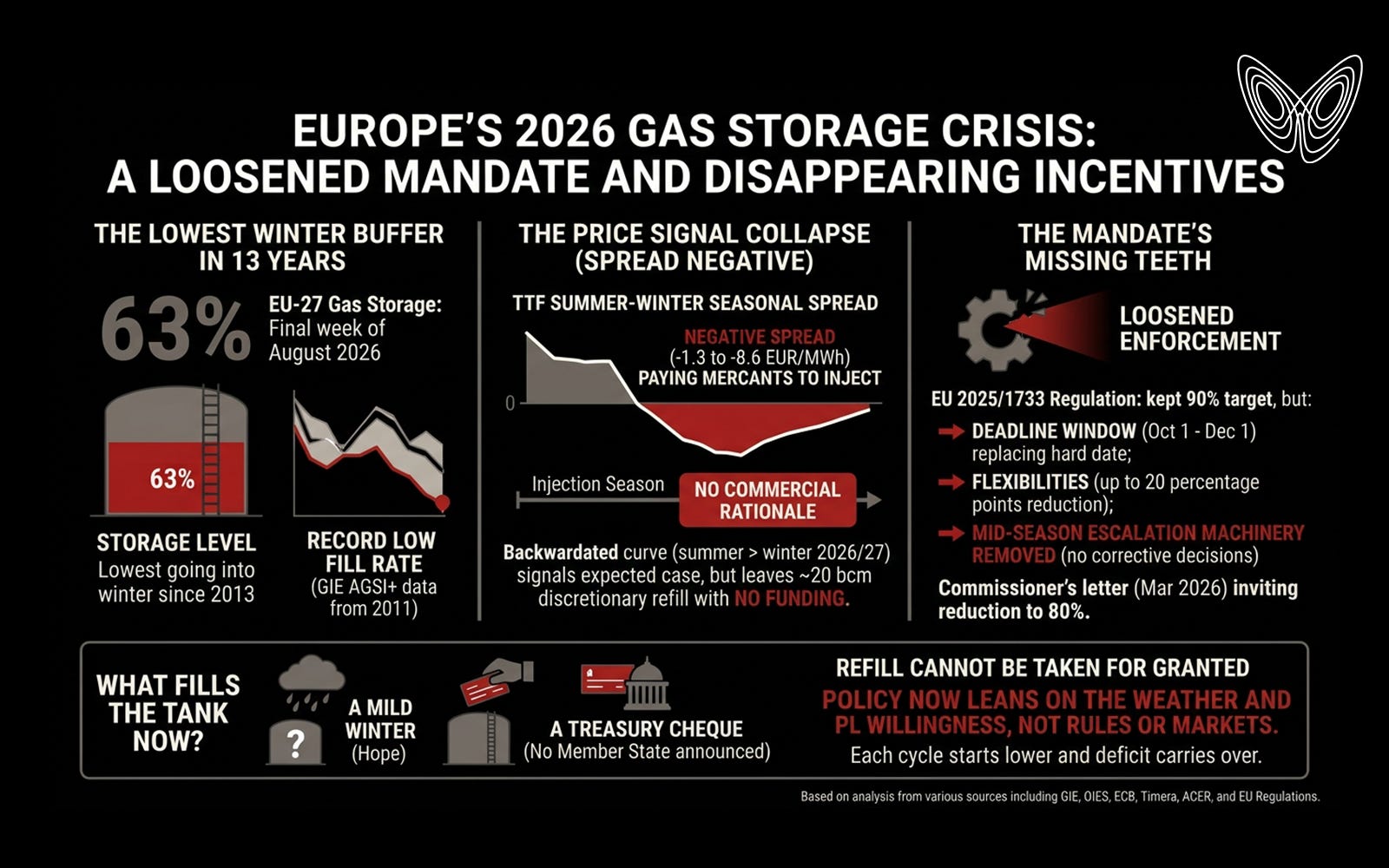
European gas storage went into September 2026 holding roughly 71.5 billion cubic meters, around 63% of capacity in the final week of August. The volume is the lowest going into a winter since 2013. The fill rate is the lowest for late August in the GIE AGSI+ record, which begins in 2011.1
Most coverage read this as a weather story with a lag. Injection started slow, the reasoning goes, and the forward curve shows the gap closing on roughly the normal path into winter.
The forward curve does imply that path. It does not cause it. Something has to move gas from a ship into a cavern before December, and this year the two things that make that happen are both slack: the price signal that pays a merchant to inject, and the rule that makes a government insist on it.
The Rule Exists Because Russia Left
Before 2022 there was no EU-wide filling target, because there did not need to be one. Russian pipeline gas was swing supply: cheap, abundant, and available in a cold January whatever the summer curve had done. A thin seasonal spread did not matter when the supplier of last resort would sell you the molecule anyway.
Before 2022, Europe did not need a filling mandate. It had Russia.
That ended when Gazprom chose to end it. It withheld storage refill and spot volumes through the second half of 2021, the price spike that followed triggered the crisis, and pipeline flows then collapsed: from about 62 bcm in 2022 to roughly 25 in 2023 and 32 in 2024, with Ukraine transit stopping entirely on January 1, 2025. What remains is TurkStream volumes that never reach northwest Europe. For practical purposes the swing supplier is already gone, and the 2027 ban closes a door that is most of the way shut.2
The 90% target in Regulation (EU) 2022/1032, passed four months after the invasion, was the administrative replacement: a rule that forces the buffer Russia used to provide. It has never actually had to force a hard fill. Storage hit 90% early in both 2023 and 2024, but those years had collapsed demand, loose LNG, mild winters and positive spreads. Whether the rule would have delivered in a bad year was never tested. This is the year it gets tested, and the version on the books is not the one that was written.
The Spread That Pays Nobody to Inject
Dutch TTF has been backwardated through the refill season. The summer 2026 contract traded above winter 2026/27. Across the second quarter the seasonal spread averaged about minus 1.3 euros per megawatt-hour, reaching minus 8.6 at the March low when Gulf transit risk spiked, and it had only narrowed back toward zero by late August.3
A flat seasonal spread is not itself a problem. It is the market saying, in price, that it does not expect a scarce winter, and it may well be right about the average. The point is what that leaves uncovered.
Full-cycle storage economics need a summer-winter spread of roughly 2.5 to 3 euros per megawatt-hour to pay: enough to cover the injection cost, the financing of gas held for six months, and the withdrawal. This year the spread has not been low. It has been negative. The buy-winter, sell-summer, inject trade books a locked-in loss before it starts, and the European Gas Hub, Timera and ACER have all said the same thing through the season: with the spread where it is, discretionary injection has no commercial rationale.4
That is not a small carve-out. Europe’s roughly 100 billion cubic meters of working storage divides into a layer that gets filled because a rule requires it and a layer that gets filled because the spread pays for it. The second layer is the part with no economic reason to fill in 2026. Call it 15 to 25 bcm, the volume a normal contango year injects above the mandated minimum: the figure is illustrative rather than modeled, but it is the same order of magnitude as the gap the Oxford Institute for Energy Studies already projects, 67% full on November 1 against a normal 90%-plus, if injection merely matches last year’s pace.
A backwardated curve does not just signal expected easing. It leaves the discretionary part of the refill, on the order of a fifth of the tank, with nothing paying for it.
It Has Happened Before, But Not Like This
Setting aside the enforced minimum, a low-spread tank still fills when one of five things is true: gas is cheap enough that negative carry barely costs anything, the tank starts near full so the gap is small, a supply cliff scares everyone into pre-stocking, the state buys the gas itself, or the option value of holding inventory against a volatile winter is large enough to justify the loss on the spread. The first four are discrete and checkable. The fifth is the residual, and it has never on its own filled a big gap on a deadline.
2019 filled to record levels on a compressed spread, and it had two of the five: TTF averaged in the low teens that year against roughly fifty now, and the expiry of the Russia-Ukraine transit contract gave every buyer a reason to pre-stock. 2022 filled to 95% on a deeply negative spread, and it had state money: Germany’s KfW credit line, and a demand-starved Asia, taken up below. 2023 and 2024 are not weak-spread cases at all, but they had the full-tank condition anyway; both started from record-high troughs after mild winters. In April 2024 EU storage was close to 60% full, its highest ever for the date.5
2026 has none of the first four. The spread has been negative through the injection window. Prices are near multi-year highs, not lows. No supply cliff is driving defensive stocking, because the Russian phase-out is known and staged. The tank started around 28% in April, the lowest in the record. And no state has stepped in. The fill is running on option value and the enforced floor, with no escalation behind them if it falls short.
Cheap gas, a full tank, a stocking scare, or a state check. Every low-spread year that filled had one. This one is left with the residual.
The Mandate Was Loosened, Then the Commissioner Wrote a Letter
Regulation (EU) 2025/1733, in the Official Journal on 10 September 2025, keeps the 90% target but changes the machinery around it.6 The hard November 1 deadline becomes a window: the target has to be hit at any one point between October 1 and December 1. The intermediate monthly checkpoints become a trajectory member states “shall strive to follow” rather than a binding path. A member state may now come in up to 10 percentage points below target in difficult conditions such as an unusually narrow summer-winter spread, with another 5 available for states with significant domestic production or long injection needs, and a further 5 by Commission act. The scheme runs to the end of 2027.
On March 20, 2026, with EU storage near 30% full, Energy Commissioner Dan Jørgensen wrote to member states inviting them to “make use of these flexibilities and consider reducing your filling target to 80% as early as possible in the filling season.”7
The headline change is small in volume: 90% to an 80% working floor is about 10 bcm across the EU, and 75% another 5. The change that matters is not the number. It is that the trajectory stopped carrying consequences. Under the 2022 rule, a member state that fell more than five points below the trajectory had to take corrective measures at once; a sustained shortfall drew a Commission recommendation, and one it had not fixed within a month could be met with a binding Commission decision forcing action. The 2025 amendment keeps the trajectory as a path member states “shall strive to follow” and drops that escalation. What has gone is the machinery that could have forced a mid-season correction when the market was not delivering one.
That machinery was never actually used, because storage ran ahead of the trajectory in both 2023 and 2024. So this removes an on-paper backstop before its first hard test. That is a real change, and a counterfactual one: it is the removal of a rule that had not yet had to work rather than the failure of one that did.
2022 Cuts Both Ways
The year cited as proof the mandate works is 2022, and the ledger is not one-sided.
EU storage reached 95% by November 1, 2022, above the 80% target then in force. It did so against a live and accelerating Russian pipeline cut into an already tight market, which is a harder task than this winter faces. And it did so with two supports this winter lacks: Asian LNG demand fell about 7% as China stayed locked down, ceding a record volume of cargoes to Europe, and where filling ran against the economics the state paid for it directly, most visibly Germany’s multi-billion-euro KfW credit line to its market operator to buy gas no merchant would.8
What 2022 proves is narrow: the system fills the tank when the political will is absolute and the money is on the table. The question for this year is whether the will is there. The Commissioner’s letter is a partial answer.
The Gulf Dug the Hole. It Will Not Fill It Back In.
The reason the tank is this low in the first place runs through the Gulf, and it is partly a one-off.
In late February 2026, strikes around the Persian Gulf put a risk premium back into oil and LNG freight. Roughly a fifth of global LNG trade transits the Strait of Hormuz, almost all of it Qatari and Emirati, and about 83% of that volume normally goes to Asia.9 A US-Iran memorandum in June was read as clearing the transit risk, and European gas sold off; part of that was a rational unwind of the premium, which the ECB has documented.10 Through the first half of the year the Asian bid did the rest. The TTF-JKM spread moved from a European premium of about 0.9 dollars per million Btu in the first two months to an Asian premium through the second quarter, and Atlantic cargoes followed the higher price east.11 European injection ran slow through the weeks it most needed to run fast.
That Q2 cargo diversion explains a large part of the deficit, and it reversed in August: with the premium compressed and European prices near multi-year highs, flexible cargoes were netting back toward Europe.12 The energy molecules are available again.
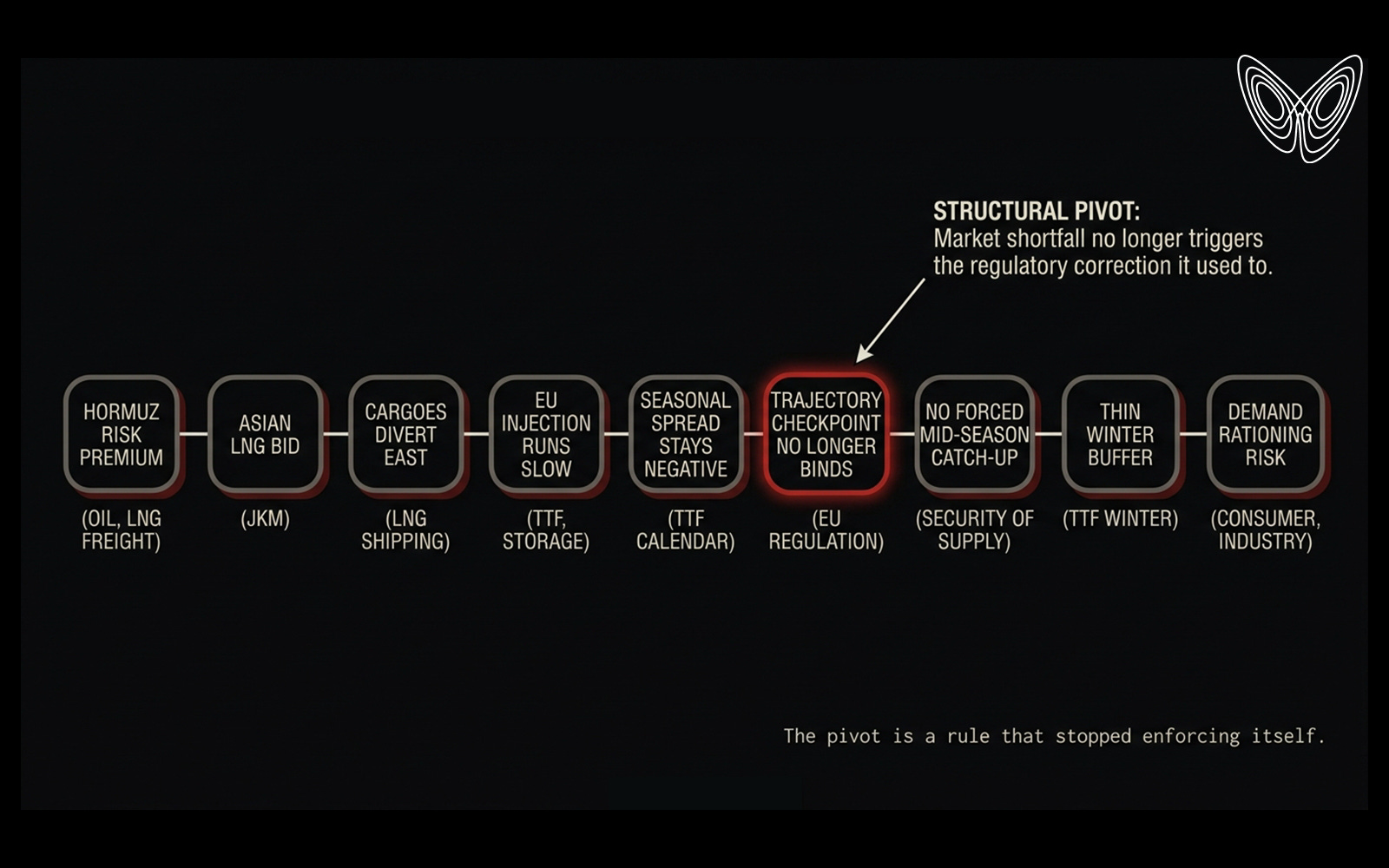
The structural question is what happens from here. The gas can be bought. What is missing is a reason to put it underground rather than sell it prompt. The pivot in this chain is not a missile and not a shipping lane. It is that the spread makes injection a losing trade and the rule that would otherwise force the choice has had its mid-season teeth pulled.
What Fills the Tank Now
Set aside this winter’s weather, which nobody can forecast in ways that matter, and the structural picture is simple. Two things fill a gas tank against a low start: a price curve that pays a merchant to inject, or a rule that requires a government to. This year the first books a loss and the second no longer bites. The supplier that used to make both redundant, Russian swing gas, is down to about 12% of imports and mostly reaching states that cannot move it north.13
Europe spent three years writing a rule to replace the supplier it lost. It took the enforcement out of the rule before the loss was fully absorbed.
What is left is two fallbacks. The first is that demand stays mild and LNG stays loose, so the thin tank is never tested. That is a hope. The second is that governments do what Germany did in 2022, and commit balance-sheet and Treasury money to fill storage the market will not. That worked once, at a fiscal cost most finance ministries would rather not repeat, and as of this writing no member state has announced a new, funded, above-market procurement line on that scale for this cycle.
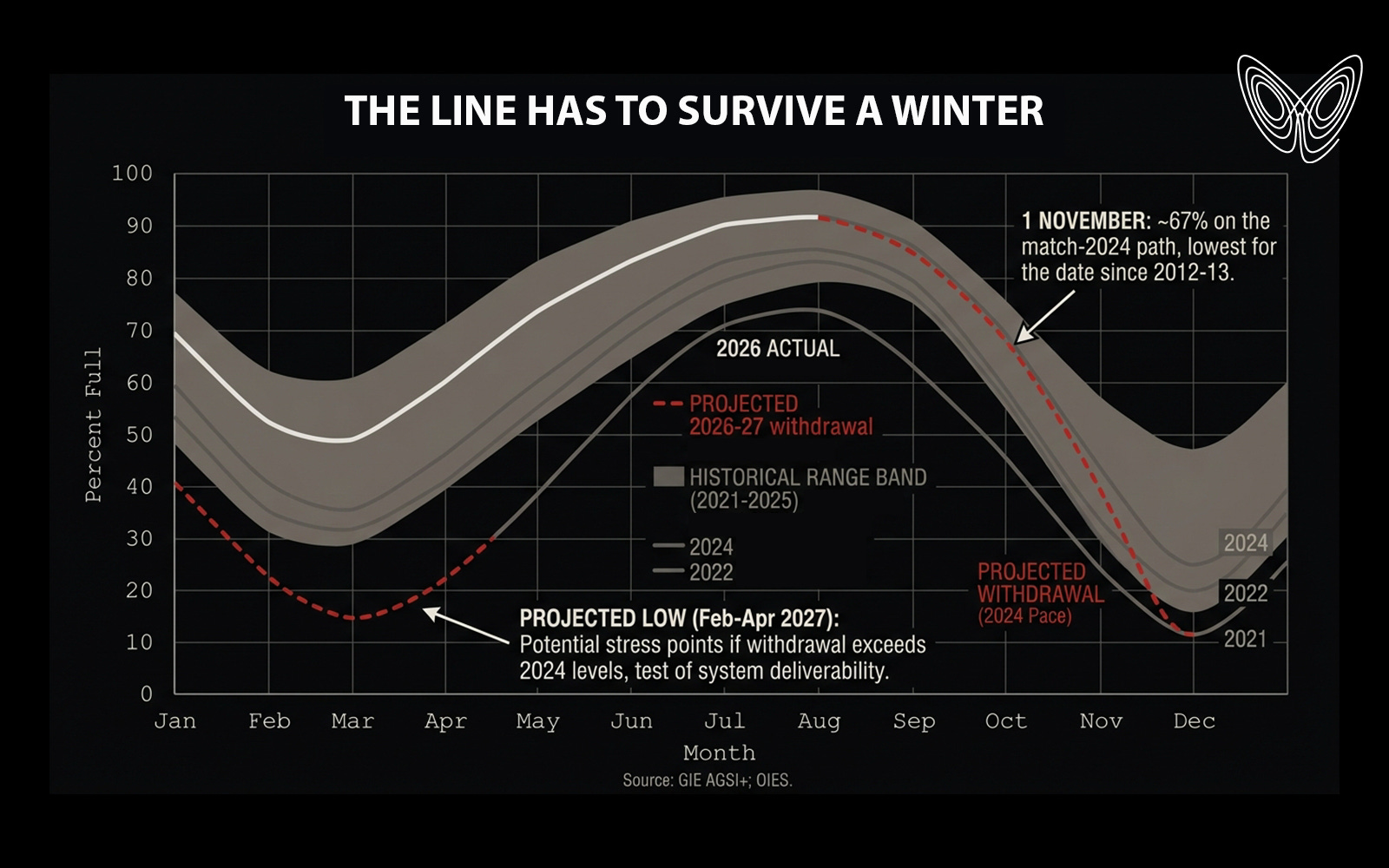
The trajectory that follows is not a price. It is a level. The Oxford Institute for Energy Studies modeled it in July 2026: if injections from July to November merely match the 2024 pace, EU storage reaches about 72 billion cubic meters, 67% full, on November 1, the lowest for that date since 2012 or 2013.14 From there the tank has to get through winter more than 20 billion cubic meters short of a normal starting buffer, then refill again from a deeper hole the following summer, into the same conditions.
None of this means the coming winter breaks. ENTSOG’s base case carries Europe through above 30%, and the wider market is loose. It means the refill has stopped being something the system does on its own. Each cycle now starts lower and leans harder on the weather and on political willingness, and the deficit carries into the next one.
What refills the tank now is a mild winter or a Treasury check. Neither is a policy.
If It Gets Tested This Winter
The near-term version of the same problem is a price event, and it is genuinely conditional.
The risk is not in the injection season. Filling from 63% toward 80% is limited by time and economics, not physics. The risk is in the withdrawal season. A storage facility’s deliverability, the gas it can send out per day, falls as working gas is withdrawn and reservoir pressure drops, because pressure is what pushes the gas out.15 A tank that starts winter near 67% rather than 90% reaches the constrained part of that curve earlier, which means the system leans on imported LNG and on price to ration demand sooner in a cold stretch. ENTSOG’s own modeling says the base case is manageable, but its limited-LNG stress scenarios show that policy or price-driven demand response could be needed to avoid running the tank down, and it names the starting storage level as a critical variable.16
The honest limit on this leg: the two most recent stress episodes did not produce disorderly prices. The June 2026 Gulf shock moved one and two-year TTF by 12% and 2%, against 38% and 74% in 2022.17 And winter 2025-26 drew EU storage from about 83% to 28% without a cited dislocation.18 Neither settles it. The June move was a geopolitical premium unwinding in summer, with a full injection season ahead, not a physical squeeze in January. The 2025-26 draw started from a nearly full tank and reached the constrained part of the curve only at winter’s end. Starting fifteen to twenty points lower moves that point forward into the cold months. This is a tail contingent on a genuine cold and low-wind stretch and a tight LNG market at the same time. It is not the base case.
Who Pays If It Binds
Price rationing in gas is not an abstraction. It runs through two channels with a lag. Retail tariffs and price caps across Europe reset quarterly or every six months, so a wholesale spike concentrated in a cold January and February lands in household bills through spring and summer 2027, after the weather has turned and the coverage has moved on. It reaches industry first and fastest. At the 2022 peak, European producers idled around 70% of the region’s ammonia capacity when gas made the process uneconomic, and that fed through into 2023 fertilizer and food-input costs.19 The 2022 magnitude does not transfer, since that year had a physical supply cut this one does not. The transmission path does.
What OIES and the ECB Are Pricing
The consensus that the curve is right rests on balances: the global LNG capacity wave, the anticipated Russian phase-out, and the ECB’s finding that the 2026 Gulf shock moved the curve far less than 2022. The 2027 forward strip sits at 9.30 dollars per million Btu, down from 10.55 for 2026.20
None of those numbers is in dispute. The strongest version of the other side is that backwardation is simply the equilibrium of a loose market, that a thinner tank is optimal in that world, and that with cargoes back in Europe it fills anyway on prompt availability plus the mandate floor plus option value, spread or no spread.
Grant the central case. In 2023 and 2024 a thin spread carried little risk because an escalation ladder sat behind the trajectory: a shortfall past five points obliged corrective measures, and an unfixed one could draw a binding Commission decision. That ladder is the thing that has been removed. It was never climbed, because those years filled early, so the point is not that it failed. The point is that the market’s “a thinner tank is optimal” now runs with nothing behind it to override the market when it is wrong, in the first fill hard enough to matter.
Prompt availability fills the prompt market, not the cavern: a cargo that lands in October and finds winter priced no higher than summer is sold spot, not injected for six months at a loss. The mandate floor is now roughly 80%, in writing. Option value funds the residual, not the bulk. What falls between “the spot market clears” and “the floor holds” is the discretionary layer that a spread, a binding mandate, or a state used to cover, and this year none of the three does.
This piece does not dispute the 2027 strip. Its claim is upstream of it: the refill the annual average takes for granted, and the tail cover that made a thin one safe, are both thinner than they were.
What Would Show This Is Wrong
Two dated, observable outcomes.
The under-fill claim fails if EU-27 storage reaches 83% or higher at any point in the October 1 to December 1, 2026 window. That is roughly what 2025 managed and roughly what the Commissioner’s letter points at. If the tank fills to there, option value and the softened mandate covered the discretionary layer after all.
The tail-cover claim fails if EU-27 storage holds comfortably above 30% through the February-to-April 2027 low in a winter that actually delivers the stress: at least one calendar month between December 2026 and February 2027 in which population-weighted heating demand runs well above the ten-year norm, roughly 10% or more in heating-degree terms, while northwest European wind generation runs roughly 20% or more below its seasonal average. A mild or windy winter that ends above 30% does not test it, because the claim is conditional on that combination arriving. If it arrives and the buffer holds, the thin start had more slack than this argues.
An outcome between 80% and 83% fill is partial: the softened mandate held a floor the market alone would not have, which is consistent with the thesis while blunting the near-term consequence. There is no unconditional price target here. The thesis is about the refill and the buffer, and it should be judged on those.
The State of the Tank
Europe can get the gas. The cargoes turned back in August. What it cannot easily get is the chain of decisions that used to move that gas from a ship into a cavern before December on its own, because the spread that paid for those decisions has been negative and the rule that compelled them now has an off-ramp the Commission has pointed at.
For two winters, a hard mandate stood in for the supplier of last resort Europe lost in 2022. This winter the supplier is nearly gone and the mandate keeps its number but not its enforcement, and storage is lower for the season than in any year since the records began. The forward curve still prints a number for winter, and on the average it is probably right. It was never built to price the winter the rule behind the refill lost its teeth.
The author allocates capital professionally and may hold positions in the asset classes discussed. This is analysis, not advice. Your decisions are your own.
Sources
EU storage held roughly 71.5 bcm in early September 2026, about 63% of capacity in the last week of August. The volume is the lowest ahead of a winter since 2013; the late-August fill rate is the lowest in the GIE AGSI+ series, which begins in 2011. GIE AGSI+; The Guardian, 29 August 2026; S&P Global, 17 August 2026.
The EU had no bloc-wide storage filling target before Regulation (EU) 2022/1032 of June 29, 2022, which introduced the 90% obligation (80% for 2022) and was adopted roughly four months after the invasion of Ukraine as part of the response to the supply shock. Russian pipeline gas was the EU’s largest single source of gas imports before 2022, around 40%. In the second half of 2021 Gazprom declined to refill the European storage it controlled and limited spot sales, a widely cited proximate trigger of the price spike that preceded the 2022 crisis. Russian pipeline supply to the EU then fell from about 62 bcm in 2022 to roughly 25 bcm in 2023 and 32 bcm in 2024 (from about 140 bcm in 2021); transit via Ukraine ceased on January 1, 2025, leaving TurkStream (serving Bulgaria, Serbia and Hungary) as the only pipeline route, and total Russian gas fell to about 12% of EU imports by 2025. Storage reached the 90% target ahead of the 1 November deadline in both 2023 and 2024. EUR-Lex, Regulation (EU) 2022/1032; IEA, “Anatomy of a natural gas crisis”; Bruegel, “The end of Russian gas transit via Ukraine and options for the EU”; European Commission, “EU reaches 90% gas storage target ahead of winter,” 18 August 2023.
The TTF summer-winter 2026 seasonal spread averaged about minus 1.3 EUR/MWh across the second quarter of 2026, reaching a low near minus 8.6 EUR/MWh on March 3 on Gulf transit risk, and had narrowed back only to around zero by late August. A negative seasonal spread makes the traditional storage trade loss-making. IEA, Gas Market Report Q3-2026; Timera Energy, “European gas seasonal spreads move back toward positive territory”.
Full-cycle summer-winter storage economics are generally cited as breaking even around 2.5 to 3.0 EUR/MWh; below that, and certainly at a negative spread, discretionary injection loses money and the value of holding storage shifts from the intrinsic calendar spread to the extrinsic option on winter volatility. European Gas Hub, “European gas storage injections slow as summer-winter spreads turn negative”; European Gas Hub, “European gas storage targets face growing pressure from weak market incentives,” 8 July 2026; Timera Energy, “European gas storage: intrinsic to extrinsic value shift”; ACER, gas storage assessment.
In 2019, record LNG imports into a global glut, low prices (TTF full-year average in the low teens, falling toward the low single digits by year-end) and pre-stocking ahead of the Russia-Ukraine transit-contract expiry carried EU storage to record levels; stocks entered March 2020 at about 60%, the highest ever for the date. The TTF curve was in clean contango through the 2024 injection season on record-high inventories. EU storage troughed in the mid-50s in spring 2023 and close to 60% in spring 2024, each a record high for the date at the time, against roughly 28% in April 2026. US EIA, “European natural gas storage inventories are at record-high levels at the end of winter”; ING, “Europe exits winter with record gas storage,” April 2024; Rigzone, 15 April 2024.
Regulation (EU) 2025/1733 of July 18, 2025, published in OJ L 2025/1733 on September 10, 2025, amends Articles 2, 6a to 6d, 17a, 18a and 22 of Regulation (EU) 2017/1938. It keeps the 90% target, allows it to be met at any point between October 1 and December 1, downgrades the filling trajectory to a level member states “shall strive to follow,” permits deviation of up to 10 percentage points in difficult conditions plus 5 for states with significant domestic production or long injection windows plus a further 5 by Commission delegated act, and extends the scheme to December 31, 2027. Under the 2022 regime it replaced, Article 6a(10) of Regulation (EU) 2017/1938 obliged a competent authority to “without delay, take effective measures” where filling ran more than five percentage points below the trajectory, and Article 6a(11) empowered the Commission, after a recommendation, to “take a decision as a measure of last resort” requiring remedial measures. EUR-Lex, Regulation (EU) 2025/1733; EUR-Lex, Regulation (EU) 2022/1032, Article 6a; Council of the EU, 18 July 2025.
On March 20, 2026, with EU storage near 30% full, EU Energy Commissioner Dan Jørgensen wrote to member states inviting them to “make use of these flexibilities and consider reducing your filling target to 80% as early as possible in the filling season.” Euronews, 23 March 2026.
EU underground storage reached 95% of capacity by November 1, 2022, above the 80% target then in force, and did so against a sharp and continuing reduction in Russian pipeline flows. Filling was aided by a roughly 7% fall in Asian LNG demand that year, which redirected record LNG volumes to Europe, and by direct state support where injection ran against the economics, notably Germany’s multi-billion-euro KfW credit line to its market operator Trading Hub Europe for storage procurement. Gas Infrastructure Europe, 9 November 2022; IEA, “Anatomy of a natural gas crisis”; Reuters, via World Energy, 19 June 2022.
About one-fifth of global LNG trade transited the Strait of Hormuz in 2024, almost entirely from Qatar and the UAE, with roughly 83% of that volume bound for Asia. EIA, via LNG Industry, 25 June 2025; IEA, Strait of Hormuz.
The shock was the late-February 2026 Gulf strikes; the US-Iran memorandum was signed in June and European gas sold off on it. The ECB documents the Hormuz risk premium and the Europe-Asia LNG spread compressing on the interim agreement. Time, 19 June 2026; ECB Blog, 27 July 2026.
The TTF-JKM spread moved from a European premium of about 0.9 USD/MMBtu in January-February 2026 to an Asian premium through the second quarter, pulling Atlantic cargoes east. IEA, Gas Market Report Q3-2026; IMF, Global price of LNG Asia (FRED: PNGASJPUSDM); US EIA, Natural Gas Weekly Update.
By August 25, 2026, flexible cargoes were netting back toward Europe rather than Asia, with TTF front-month near multi-year highs. The IMF monthly EU gas series runs in the low-to-mid 50s EUR/MWh through July 2026 and rising; some secondary August reporting cites 62 to 70. Timera Energy, “Gas & LNG market state of play in 5 charts”; IMF, Global price of Natural gas EU (FRED: PNGASEUUSDM); RANE Worldview, 26 August 2026.
The EU ban on Russian LNG under long-term contracts takes effect on January 1, 2027, with the pipeline ban from autumn 2027. Russian pipeline gas and LNG together were about 12% of EU gas imports (roughly 37 bcm) in 2025, behind Norway (about 30%) and the United States (about 28%), and since the end of Ukraine transit the remaining pipeline volume runs via TurkStream to Bulgaria, Serbia and Hungary. Council of the EU, 26 January 2026; European Parliament, 11 December 2025.
If July-to-November 2026 injections merely match the 2024 pace, EU storage reaches about 72 bcm, 67% full, on November 1, 2026, the lowest for that date since 2012 (71 bcm) or 2013 (74 bcm). OIES, “European Storage Refill in Summer 2026” (Jack Sharples and Ricky Hill), July 2026.
A storage facility’s deliverability “is at its highest when the reservoir is most full and declines as working gas is withdrawn,” and “varies directly with the total amount of natural gas in the reservoir.” US EIA, “The Basics of Underground Natural Gas Storage”.
ENTSOG’s Summer Supply Outlook 2026 with Winter 2026/27 overview finds that from the 28% low on April 1, 2026, injection and withdrawal capacity are sufficient to get every member state through winter 2026-27 above 30%, provided supply holds; its limited-LNG stress scenarios show that policy or price-based demand response could be needed to avoid depletion, and identify the storage level at the start of the withdrawal season as a critical variable. ENTSOG, Summer Supply Outlook 2026.
The ECB finds one and two-year gas futures rose 12% and 2% during the 2026 Iran conflict, against 38% and 74% during the Ukraine conflict. ECB Blog, 27 July 2026.
The TTF summer-winter spread was inverted in February 2025 but flipped to contango for the 2025 injection season as prices fell; EU storage still finished the summer of 2025 around 82% full, and winter 2025-26 drew it to about 28% by April 1, 2026, the lowest in four years. Euronews, 8 July 2026; OIES, “EU Gas Storage Regulation,” Insight 174, November 2025.
At the August 2022 gas-price peak, the European fertilizer industry curtailed around 70% of the region’s ammonia production capacity, with gas accounting for up to 90% of variable cost; the shortfall fed into 2023 nitrogen and food-input costs. European Commission, “Ensuring the availability and affordability of fertilisers,” COM(2022) 590; Fertilizers Europe, 15 September 2022.
OIES puts the TTF forward strip at 10.55 USD/MMBtu for 2026 and 9.30 for 2027, against LNG capacity additions running well ahead of demand growth through 2030. OIES, “The LNG Wave in 2026/2027” (Mike Fulwood), February 2026.